Most Lahore parents shopping for an early-years school for a three or four year old end up confused by the same two words: Cambridge and Montessori. The brochures use them as if they were different brands of the same thing, but they are not even the same kind of thing.
This guide is the conversation we have on every campus tour with first-time school parents. It explains what each one actually is, what a classroom looks like in practice, what each costs in Lahore, and how to choose for your specific child. It is written by a school that runs Cambridge, but the goal here is honesty, not persuasion. There are real reasons to choose either, and we will say where Montessori may be the better fit for your child.
The one-line answer most parents need first
Cambridge is a curriculum. Montessori is a teaching method. They are different categories of decision — like asking "do you want Italian food or to eat with chopsticks?" The two questions can have separate answers, and a school can combine them in surprising ways.
- Cambridge is content. It tells the school what to teach: what a child should know in maths, English, science, and other subjects at each age, leading to international qualifications (Checkpoint, IGCSE, A-Level).
- Montessori is method. It tells the school how to teach: classrooms with self-directed activity, hands-on materials, mixed-age groups, and minimal whole-class instruction.
You can have a Cambridge school taught in a Montessori-style room. You can have a Montessori school that does not touch Cambridge content. And in Lahore, most schools advertised as one are not the other.
What a Cambridge classroom actually looks like
A typical Cambridge primary classroom in Lahore has 18 to 25 children of the same age, a teacher at the front for some of the day, and a structured weekly timetable. The teacher follows a Cambridge scheme of work, marks weekly assessments, and reports against Cambridge learning objectives. Children sit at desks for direct teaching, then move to group activities or independent practice.
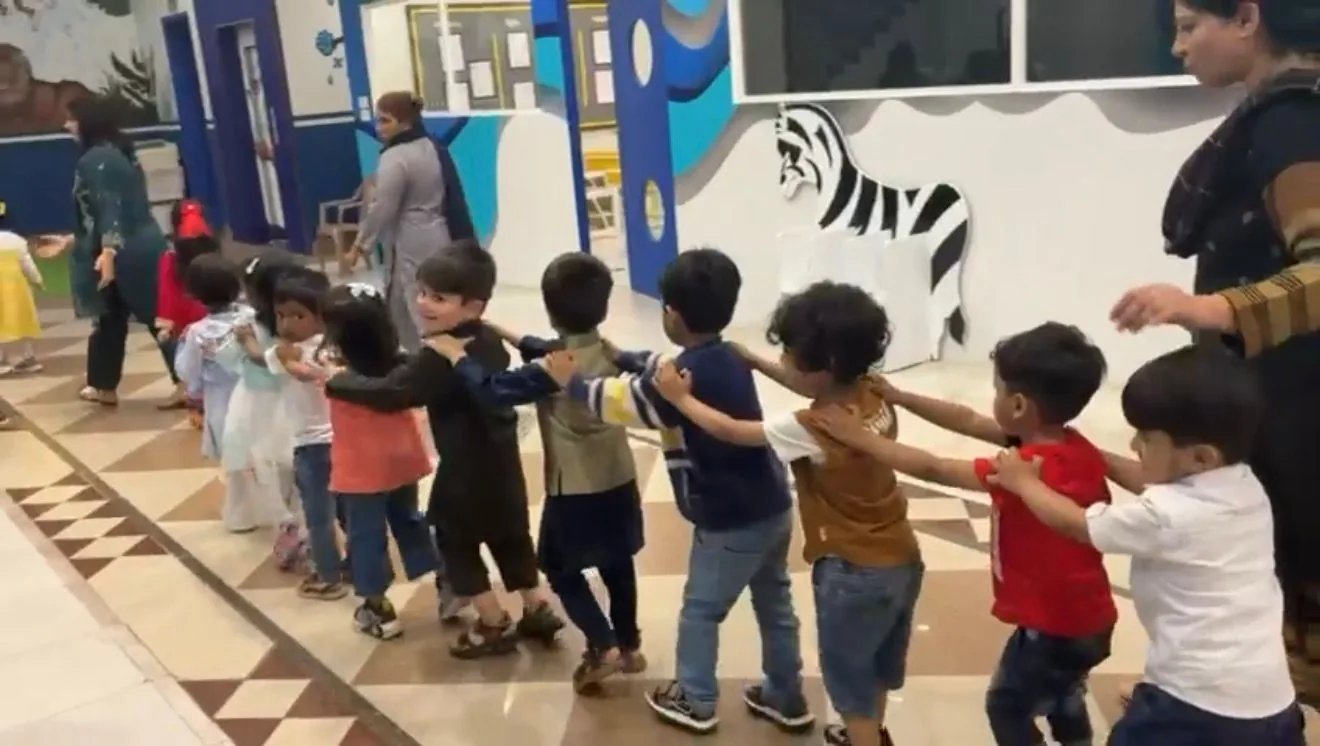
At the early-years end (Pre-Nursery, Nursery, KG), Cambridge schools have flexibility. A well-run Cambridge Nursery often borrows from Montessori principles — labelled trays, child-height furniture, choice time, concrete materials before abstract symbols — while still working towards Cambridge Early Years milestones.
The defining features of a Cambridge classroom:
- Same-age peer group, with a single class teacher leading the year
- Structured timetable: maths in the morning, literacy after break, specialists for music, art, and physical education
- Weekly written work, regular short assessments, and end-of-term Cambridge-aligned reports
- Clear progression: each year builds on the last, with named learning outcomes
- Designed to feed into Cambridge Checkpoint at age 11 and IGCSE at age 14 to 16
What a Montessori classroom actually looks like
A traditional Montessori classroom in Lahore is mixed-age (typically 3 to 6 years old in one room), with 15 to 25 children and one or two trained Montessori teachers (called "directresses"). There is no front of the room. Children move freely between activity stations, choose their own work, and stay with one task for as long as it absorbs them — sometimes 45 minutes on a single set of bead chains.
The classroom looks different from a regular school: low shelves with named wooden materials, child-sized everything, no walls of stickers or alphabet posters, no whole-class teaching circle for most of the day. The teacher observes, demonstrates one-on-one, and gently redirects rather than instructing the group.
The defining features of a Montessori classroom:
- Mixed-age groups (3 to 6 in one room is the original Montessori format)
- Self-chosen work for the bulk of the morning ("the three-hour work cycle")
- Hands-on materials designed for self-correction (the child sees their own mistake)
- Older children teach younger children naturally; the teacher rarely lectures
- Minimal homework, fewer assessments, no marks, and looser progression between ages
The honest comparison for a Lahore parent
| Factor | Cambridge (early years) | Montessori |
|---|---|---|
| Best fit if your child… | Likes routine, group activities, clear instructions, peer-group friendships at the same age | Likes choosing what to do, focuses for long stretches alone, prefers hands-on to verbal |
| Class structure | Same-age peers, structured timetable, teacher-led for some of the day | Mixed-age (3 to 6), self-chosen activity, teacher observes |
| Daily pace | Defined lessons with breaks, clear start and end times for each subject | Three-hour uninterrupted work cycle, child-led pacing |
| Progression after age 6 | Continues directly into Cambridge primary (Class 1, Class 2 and so on) | Most Lahore Montessori schools end at age 6; transfer to a primary school is required |
| Pathway to IGCSE / A-Level | Direct, with no curriculum break | Requires switching schools at age 6 or 7 to get on a Cambridge track |
| Reports and assessment | Termly written reports, weekly informal checks | Observational notes, parent meetings, no marks or rankings |
| Typical Lahore tuition | Mid to high range, varies by school | Low to mid range for standalone Montessori; high for "Cambridge Montessori" hybrids |
How to choose for your specific child
The honest answer is that most three-year-olds do well in either environment, because the actual difference at age 3 is smaller than the marketing suggests. The decision matters most after age 5, when academic content and pace start to diverge. Here is how to think about it.
Choose Cambridge if…
- You want your child on an international qualification pathway from the start, with no transfer in primary
- Your child responds well to clear structure, group activities, and same-age friendships
- You plan for IGCSE, A-Level, or international university applications eventually
- You value termly reports and a defined sense of what your child has learned that month
- You are choosing a school you want your child to stay in for the long term, not switch out of at age 6
Choose Montessori if…
- Your child is independent, deeply curious, and needs to choose their own work to engage
- You are comfortable with a lower-pressure early-years experience and a school transfer at age 6
- You value the hands-on materials, mixed-age peer learning, and self-correcting work the method is famous for
- The Montessori school you have in mind is genuinely Montessori-trained — not just borrowing the name
- You have already mapped where your child will go for primary school and are confident about the transition
The "Cambridge with Montessori principles" middle path
This is what most well-run Cambridge early-years programmes in Lahore actually deliver. The classroom borrows from Montessori — labelled trays, child-height furniture, structured choice time, hands-on materials, plenty of outdoor time — but the curriculum follows Cambridge so the child is on-pathway when they reach Class 1. For families who want both the warmth of Montessori principles and the long-term clarity of Cambridge, this is usually the right answer.
To see what this looks like in practice, our week in Pre-Nursery page describes a real week of three-year-old learning at London School — the robotics corner, the playdough table, the Friday letter home — and is a good reference even if you choose a different school.
The Lahore-specific pitfalls to watch for
Both labels are heavily marketed in Lahore and not always backed by what they advertise. Three things to verify before enrolling:
1. "Cambridge" status
Search the school's name in the official Cambridge Find a School directory. If the school is not listed, it is not Cambridge Pathway Registered, regardless of what the brochure says. A non-registered school cannot enter your child for any Cambridge exams.
2. "Montessori" training
True Montessori teachers hold diplomas from accrediting bodies such as AMI (Association Montessori Internationale) or AMS (American Montessori Society). Many Lahore schools labelled "Montessori" use the name without trained Montessori teachers on staff. Ask: "Are your early-years teachers AMI or AMS trained, or trained in another formal method?" If the answer is vague, it is a marketing label, not a method.
3. The transfer plan
If you choose a Montessori school that ends at age 6, ask the school which primary schools their previous cohort transferred to and whether they help with the application. A reputable Montessori school will have a clear answer; a school without one is leaving the most stressful part of the journey to you.
What we have settled on at London School
About this section
This is the only part of the article where we describe our own school. Skip it if you are still in the comparison phase — the comparison content above is the reason this guide exists.
London School — Prof. Waris Mir Campus runs the Cambridge Pathway from Pre-Nursery to Class 7, with Class 8 launching in 2026–27. Our early-years rooms borrow heavily from Montessori principles — labelled trays, child-sized furniture, structured choice time, plenty of outdoor play — while the curriculum follows Cambridge so children move directly into Class 1 without a school change.
The difference for a parent is that you do not have to choose between method and pathway. Children stay with us through primary, and the same room that feels Montessori at age 3 is the room that prepares them for Cambridge Checkpoint by age 11.
See it in person
The fastest way to know whether the early-years approach suits your child is to visit. Our Pre-Nursery and Nursery classrooms are open on Thursdays for parents on a campus tour.
Book a Campus Tour on WhatsAppFrequently asked questions
What is the difference between Cambridge and Montessori in Lahore?
Cambridge is a curriculum (the academic content). Montessori is a teaching method (how the classroom is run). They are not the same kind of decision and a single school can combine both. In Lahore, most "Cambridge" schools are not Montessori, and most "Montessori" schools do not follow Cambridge content.
Is Montessori better for a 3 year old than Cambridge?
Neither is universally better. Montessori suits children who thrive on independence and hands-on materials. A structured Cambridge early-years programme suits children who do well with daily routines and group activities. For families planning Cambridge primary or international secondary, starting with Cambridge avoids a school transfer at age 6.
Can my child switch from Montessori to Cambridge later?
Yes, transfers from Montessori to Cambridge primary at age 4, 5 or 6 are common. The transition is usually smooth socially. Academically the child may need a short adjustment to the more structured pace and weekly assessments of Cambridge primary.
Are Montessori schools in Lahore Cambridge-recognised?
Most are not. Standalone Montessori schools in Lahore typically end at age 6, after which children transfer to a separate primary. A small number market themselves as "Cambridge Montessori" but parents should verify on the official Cambridge International "Find a School" directory before enrolling.
Does Cambridge primary use Montessori-style materials?
Some do, especially in early years. A well-run Cambridge Pre-Nursery and Nursery often borrows from Montessori principles — labelled trays, child-height furniture, structured choice time, concrete materials before abstract symbols — while still following Cambridge curriculum content.