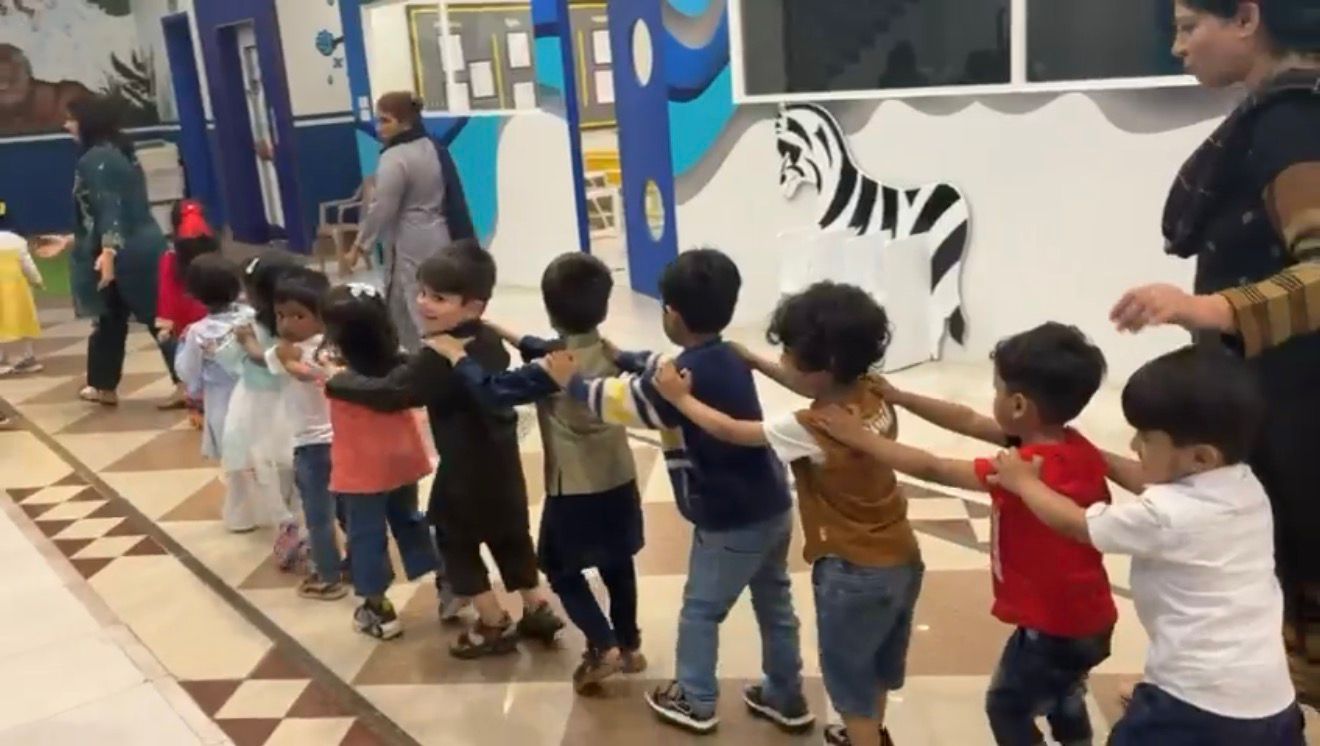
Sending your child to school for the first time is one of the bigger emotional moments of parenting. The decision feels heavier than it needs to — partly because school marketing makes it feel that way.
Here's the calm version of what actually matters when you're choosing a school for a 4-year-old in Lahore. Most of it is simpler than the brochures suggest.
What does a 4-year-old actually need from school?
At this age, three things matter, in order:
- To feel safe and happy in a place that isn't home.
- To be around a warm, attentive teacher who knows them as an individual.
- To play, explore, and gradually learn through structured activity.
That's it. Reading, writing, multilingual programmes, advanced curricula — those come later, gently, and only once the first three are in place. A child who is anxious or invisible in their classroom will not absorb academic content, no matter how impressive the syllabus looks on paper.
The single biggest predictor of how well a 4-year-old does at school is whether their teacher knows their name, their favourite toy, and what makes them cry. Everything else is downstream.
What 4-year-olds should be doing in a good early-years classroom
If you walk into a classroom of 4-year-olds, here's what you should see:
- Children moving between activities — not all sitting in rows.
- A mix of structured time (carpet stories, simple counting, phonics songs) and free play (blocks, role play, art, sand, water).
- Teachers crouched at child-eye level having actual conversations.
- Walls covered with the children's own work, not laminated posters.
- Plenty of fine-motor activity: scissors, crayons, threading, playdough.
- Outdoor or open play time scheduled into the day.
What you should not see at age 4: long worksheets, children sitting still for 40+ minutes, pressure to read fluently, or a curriculum that feels like a small Year 3.
What actually matters when comparing schools
1. Class size and adult-to-child ratio
For early years, look for 15–20 children maximum per class with at least one teacher plus one assistant. At higher ratios, individual attention becomes impossible — and at age 4, individual attention is the curriculum.
2. The teacher you'd actually be assigned
Ask to meet the early-years teacher specifically. Notice: do they make eye contact with your child? Do they kneel down to greet them? Are they patient when your child is shy? You'll feel the difference within five minutes.
3. The daily routine
Ask for a sample day. A healthy early-years day has a clear rhythm: arrival, morning circle, structured activity, snack, free play, story time, lunch, rest, outdoor play, story, home. Predictability matters enormously to small children.
4. Distance from home
This matters more than parents admit. A 45-minute commute each way means an exhausted 4-year-old by 2 PM. A school that is 80% as good but 15 minutes away will often produce a happier child than the "perfect" school across town.
5. Settling-in policy
Good schools build in a gentle settling-in week — shorter days for the first few days, parents allowed to stay for the first morning, and a clear plan for tearful drop-offs. Schools that treat the first day as "drop and run" are missing how this age works.
6. Language environment
If the school is English-medium, ask how they handle children who only speak Urdu at home. Good early-years teachers don't punish Urdu — they bridge it patiently. The goal is comfort first, language acquisition second.
7. Toilet training and snacks
Practical, but important. Will the staff help with bathroom accidents without shaming? What's the snack policy? Are children helped to eat independently?
Bring your 4-year-old to meet us
The best way to know is to come together. We invite the child for a short visit, watch how they settle, and answer every question — even the small ones about lunch and naps. No pressure, no commitment.
Book a Family VisitWhat doesn't matter as much as marketing suggests
- The size of the building. Big campuses with marble floors do not teach 4-year-olds. Warm teachers do.
- Multiple foreign languages at age 4. Children this age are still building their first language. Adding three more at once is a marketing message, not a developmental need.
- Tablets and screens in the classroom. Research is clear that 4-year-olds learn far better through hands-on materials than screens. A school that brags about iPads in early years is signalling the wrong priorities.
- How early the child is reading. Reading age varies enormously — early readers don't end up smarter, they just end up reading earlier. Pressure at age 4 can backfire badly.
- Branded uniforms and prestige. These matter to adults. They are invisible to 4-year-olds.
Is your child ready for school?
"Ready" doesn't mean academically prepared. It means socially and emotionally ready. Most 4-year-olds in Pakistan are. A few signs that suggest your child is set up well:
- Can separate from a parent for a few hours without overwhelming distress.
- Can communicate basic needs verbally ("I'm hungry", "I need toilet").
- Shows curiosity — about animals, books, other children, anything.
- Can handle simple self-care: washing hands, putting on shoes.
- Has the stamina for a half-day away from home.
If a few of those aren't quite there yet, it isn't a problem. Good schools build these in during the first term. But it's worth knowing what to expect.
The 4-year-old school visit checklist
- Class size — 15 to 20 max?
- Did the teacher engage with your child personally?
- Are children playing, moving, and talking — not just sitting?
- Is the daily routine clear and age-appropriate?
- Is there a thoughtful settling-in plan?
- Is the commute realistic for a small child?
- Did your child seem comfortable in the space?
How we approach early years at London School
Our Pre-Nursery and Nursery classes are deliberately small. Each early-years classroom has a lead teacher and an assistant. The day balances structured Cambridge Early Years activities with abundant play, art, music, and outdoor time.
We're a Cambridge Pathway Registered school — but at age 4, that's a foundation, not a pressure. Our priority is getting children to love coming to school. Strong reading, writing, and numeracy follow naturally once that's in place.
Tuition for Pre-Nursery and Kindergarten starts at Rs 15,000/month, with an early-bird rate of Rs 18,000/month available for our first 100 admissions across older grades.
Common questions
What's the right age to start school in Pakistan?
Most children start formal schooling in Pre-Nursery or Nursery at ages 3–4, with Kindergarten at age 5. Social readiness matters more than the calendar — comfort with separation, basic communication, and curiosity matter most.
What should a 4-year-old be learning?
Social-emotional skills, language, fine motor coordination, and play-based exploration. Letters and numbers are introduced gently. Reading and writing come gradually — they are not a race.
What's more important — facilities or teachers?
Teachers, by a long way. A warm, patient, well-trained early-years teacher makes more difference to a 4-year-old than any facility. Buildings don't raise children; people do.
What class size is appropriate?
For ages 3–5, look for 15–20 children maximum, with one teacher plus one assistant. Individual attention is the curriculum at this age.
How do I know if my child is ready?
If your child can separate from you for a few hours, communicate basic needs, manage simple self-care, and show curiosity about other children, they are ready. Academic skills are not prerequisites — schools build those.